Showing posts with label Racing Motorcycles. Show all posts

Sunday, 8 February 2015

Husqvarna 510 by Velomacchi

Vintage Husqvarna dirt bike built by Velomacchi.
Kevin Murray is a petrolhead with a very interesting day job: he runs a company designing high performance gear for clients like The North Face, Nike, Mammut and Navy SEAL teams.

He’s now set up shop with his own brand, Velomacchi, producing “Everyday Carry for the serious motorcyclist.” In the works are backpacks, tool rolls, iPad and iPhone storage and messenger bags. The vibe is ‘privateer racer’—functional and good value.

Vintage Husqvarna dirt bike built by Velomacchi.
It’s a very technical process, so Kevin gets his respite via the more analog pursuit of crafting vintage dirt bikes. Like this stunning flat tracker, based on a 1986 Husqvarna 510 pulled from a hedge in eastern Oregon.

“The air-cooled 510 was one of the last models built by Swedish hands,” says Kevin. “It was a legendary 4-stroke thumper with a 2-stroke style bottom end. It pulled like a semi and cut like a chainsaw, and was a great fit for our circuits in the Northwest.”

Vintage Husqvarna dirt bike built by Velomacchi.
The Husky had two serious weaknesses though: a Motoplat electrical system and a temperamental Dell’Orto 40mm carburetor. So Kevin and his crew replaced the electrical system with a German-designed MZB ignition, and installed a new Mikuni 38mm flatslide carb for a snappier throttle response.

The exhaust system is a traditional low-slung flat track design, with stainless 2-into-2 cone silencers. It’s low slung on the right to avoid exhaust burns on the thigh when turning left, and also to save it from damage in a lowside crash.

Vintage Husqvarna dirt bike built by Velomacchi.
The suspension was upgraded too, with a Kawasaki ZRX1200R front end boosted with Race Tech Gold Valve internals. Bringing up the rear is a Fox twin-clicker shock from a ZX9, hooked up to an adjustable spacer system so that the suspension can be fine-tuned. (“We machined three different-length spacers so the shock height could be quickly adjusted to fit the track.”)

The wheels went off to Buchanans, who supplied a new 19” wheel set with heavy-duty stainless steel spokes suitable for flat track racing. Meanwhile, the #2 stainless steel handlebars were hand bent by Ray Carroll, to get the perfect length and height to control the bike. “Ray is a legend in the Northwest,” says Kevin. “He maintains the Castle Rock clay track, builds custom frames and is still racing at 81 years old!”

Vintage Husqvarna dirt bike built by Velomacchi.
An added dose of style comes from the new bodywork. “We really loved the lightweight simplicity of Husky’s 1970s desert racers. So we kept the frame, engine and swing arm from the 510 and tossed the heavy plastic fairing, tank and seat. We replaced it with a brand new tank from a 1979 Husqvarna 390 OR, and a custom seat from New Church upholstery.” The seat is not fashionably slim, but it sure looks comfy.

Vintage Husqvarna dirt bike built by Velomacchi.
Now that the bike is fully sorted, Velomacchi’s focus is back onto the gear. And very interesting it looks too, providing a challenge to the likes of Kreiga and Ogio. Funding for the project has just launched on Kickstarter, and investors are piling in already.

Check it out here.

Images by Gregor Halenda.

Vintage Husqvarna dirt bike built by Velomacchi.

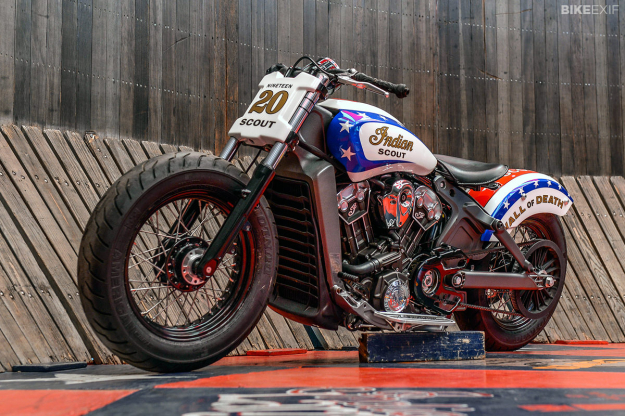
The Wall of Death Indian Scout

The current model Indian Scout has been converted into a Wall of Death motorcycle
The launch of the new Scout in Sturgis had to be more than a silly sheet-pull. So Indian Motorcycle looked to history for inspiration. Revealing the bike on a Wall of Death was the answer—with the task of creating a one-off machine falling to Indian’s own industrial design team, led by Greg Brew.

Rich Christoph, the lead designer on the production Scout, is the main man behind the Wall of Death Scout. And it’s more than just a pretty paintjob. Indian called in Jay Lightning and Charlie Ransom of the American Motor Drome Co. to figure out what mods the stock bike needed—and they’re pretty substantial.

An original Wall of Death Indian Scout
“We did some testing with Jay and Charlie at the Hog Rock Rally in southern Illinois about two months ago,” Christoph tells us. “The Scout went on the wall after the crowds had all gone. This was a rough, dirty version of the bike—in case we crashed it, or needed heavy mods. But it was a blast!”

Jay and Charlie are used to late 1920s 101 Scouts (above), which have around 19hp. But with custom headers and no mufflers, Indian’s test bike was pumping out a mighty 112hp, and the power delivery was simply too much. So an ECU recalibration was the first item on the list.

The current model Indian Scout has been converted into a Wall of Death motorcycle
The solo bucket seat—a styling highlight of the stock machine—turned out to be too narrow for Charlie to manipulate the bike on the wall. So a repro of an early Indian solo seat was created by Minneapolis-based Vinyl-lux, modified so that it could be tucked down behind the tank.

After installing it, Indian’s mechanics added a closeout panel under the seat, with a pigtail charging cord for battery maintenance. The stock tank was cut and shut by Jeb’s Metal and Speed before being painted by Indian’s own Steve Leszinski.

The current model Indian Scout has been converted into a Wall of Death motorcycle
Other mods are equally practical. The steering stop has been cut off, so Charlie can turn tight inside the ’drome and get a good lean angle. Out back, custom rear struts from Craft Pattern have been installed, so the bike can be set up with a fixed ride height. And with aluminum tubes inserted inside the front forks, it’s effectively a fully rigid frame.

The current model Indian Scout has been converted into a Wall of Death motorcycle
“Charlie wanted little or no compression at all, not even in the seat,” Christoph explains. “When he’s on the wall he’s under 3 to 4 G of compression, and he needs to be able to move around the machine easily.”

After a week-long second test in Wyoming, MN, at Indian’s own engineering center and much to the delight of by-the-book engineers, Charlie gave the Scout the tick.

The current model Indian Scout has been converted into a Wall of Death motorcycle
The Wall of Death Custom Scout will appear on the International Motorcycle Shows circuit, and may perhaps perform again. Although it’s a custom, this bike was built to ride—on its side.

Mechanical work and tuning by Sheik Ahmed and Chet Michaelson. CAD design by Jim Rogala. Images by Barry Hathaway. For more information on the new Scout, check out the Indian Motorcycle website.

The current model Indian Scout has been converted into a Wall of Death motorcycle

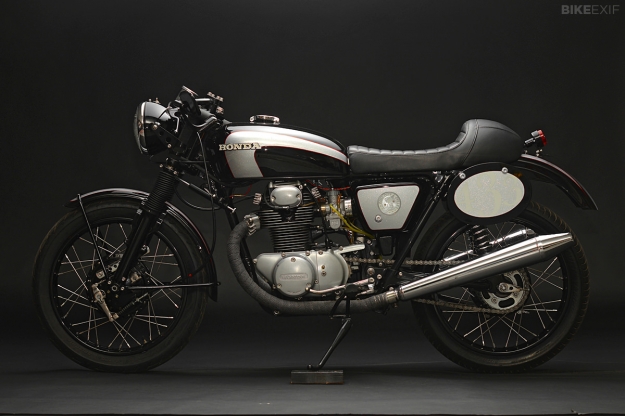
Honda CB 350 AHRMA racer

1972 Honda CB 350 Cafe Racer / AHRMA Production Class Racer built by Jason Paul Michaels and Scott Turner.
The term ‘café racer’ is bandied about so much these days, it’s virtually lost all meaning. But this sleek Honda CB 350 is one of the few modern customs that live up to the moniker. Even better, it’s fresh out of the workshop and ready to race in the AHRMA Production Class race series—if you can bear the thought of putting a scratch on that immaculate bodywork.

It’s the personal project of Jason Paul Michaels, co-founder of Dime City Cycles and a man who knows a thing or two about building bikes. Michaels is not too vain to call in extra help though, and in this case, he approached Scott Turner, the multiple Daytona-winning AHRMA Sportsman 350 national champion. How’s that for a pedigree?

1972 Honda CB 350 Cafe Racer / AHRMA Production Class Racer built by Jason Paul Michaels and Scott Turner.
For Michaels, building the bike was a release from the pressure of running one of the most successful aftermarket parts companies in the USA: “A way to blow off some steam, and take a break from the daily rigors at Dime City,” he says. “Scott shared quart after quart of knowledge on perfecting the CB 350. To use his words, we wanted it to be ‘the funnest bike there is to race!”

It’s a ground-up rebuild, torn down 100% and reassembled from scratch. Scott’s input extended to the tiniest details: Little things like back-cutting the transmission gears, installing solid chain rollers, and taking a notch out of the points case. (And adding a few extra washers here and there, “Because they just need to be there.”)

1972 Honda CB 350 Cafe Racer / AHRMA Production Class Racer built by Jason Paul Michaels and Scott Turner.
Building a race bike involves a learning curve. “When working with a seasoned builder and racer, there are things they figure out—due to necessity on the race track—that street builders like myself would never uncover,” says Michaels.

The mid-controls are a case in point. AHRMA Production Class rules dictate that a bike must be as close to stock as possible—including the fenders, seat, carburetors, a period-appropriate exhaust and so on.

So the mid controls on this Honda CB 350 were custom fabricated to push the limits of what AHRMA rules allow with back and upward placement, along with several other little tweaks. “To hit the track, we only need to use the quick disconnects built into the harness to remove the headlight, then swap in the number plate and fasten the belly-pan to the bottom,” says Michaels.

1972 Honda CB 350 Cafe Racer / AHRMA Production Class Racer built by Jason Paul Michaels and Scott Turner.
The mechanical spec is high end, with an engine completely rebuilt using .50 over pistons, Mikuni VM30 carbs, custom headers and Norton peashooter mufflers. It’s a bike designed to go fast.

Unfortunately, it will not be Michaels riding it. He’s a man with very little spare time, and honest enough to voice fears that he’d lay it down if he rode it in a race. “Scott hasn’t backed off, and I’m sure he’ll get me on the track sooner rather than later—but it’ll be on a different bike.”

1972 Honda CB 350 Cafe Racer / AHRMA Production Class Racer built by Jason Paul Michaels and Scott Turner.
So Michaels has decided to put the CB 350 up for sale. “The bike isn’t ‘brand new,’ it’s as-new. It has approximately 600 miles after the complete rebuild and got full adjustments to valves and other items at the 500-mile break-in mark. It’s a turnkey bike read for anyone to ride. Just a couple of kicks, and you’re on your way to the ton.”

Tempted? Contact Jason Paul Michaels via the Dime City Cycles website.

Images by Erick Runyon.

1972 Honda CB 350 Cafe Racer / AHRMA Production Class Racer built by Jason Paul Michaels and Scott Turner.
Specification

Complete Engine Rebuild w/ Powder Coated Covers & Cases
.50 Over Pistons
Back-cut Transmission Gears
Tensioner Wheels Replaced w/ Solid Delrin CAM Chain Sliders
Polished Fins
Custom Headers w/ Norton Peashooters Mufflers
Mikuni VM29 Carburetors w/ Emgo Throttle & Aluminum Velocity Stacks
Vintage Finned Valve Tappet Covers
All Stainless Steel Fasteners
New Chain & Sprockets

Gloss Black & Silver Flake Paint-job by Kevin Bates
Vintage Red hand pinstripes by Liza Hopkins
Stock CB 350 Tank w/ New Gas Cap & Petcock
Stock CB 350 Rear Fender
Stock CB 350 Front Fender
DCC Original Headlight & Ears
Lossa Engineering Handlebars
DCC Original Cafe Racer Seat w/ Flip-up Hinge
DCC Original Classic Retro Round Taillight
Hand-made Aluminum Number Plates
All Stainless Steel Fasteners
Stock CB 350 Seat pan with DCC Original Cafe inspired seat covering

Front Avon Race Compound Tires w/ Stock Wheels Powder-coated Black w/ Stainless Steel Spokes & Nipples
Rear Avon Race Compound Tires w/ Stock Wheel Powder-coated Black w/ Stainless Steel Spokes & Nipples

New Custom Harness
Dyna Coils w/ Points Ignition
Anti-Gravity Battery
Ricks Electric Hot-shot Regulator / Rectifier Combo

Stock CB 350 Frame Powder-coated Gloss Black
Progressive 412 Rear Shocks
Progressive Front Springs w/ Fork Gaiters
CB 400F Top Triple Tree Powder-coated Black w/ Tapered Bearings
CB 350 Lower Triple Tree w/ Tapered Bearings
DCC Original Steering Damper Kit

Stock CB 350 Front Drum (EBC Shoes w/ Turned Hub) *All Hardware Re-chromed, Motion Pro Cable
Stock CB 350 Rear Drum (EBS Shoes w/ Turned Hub)

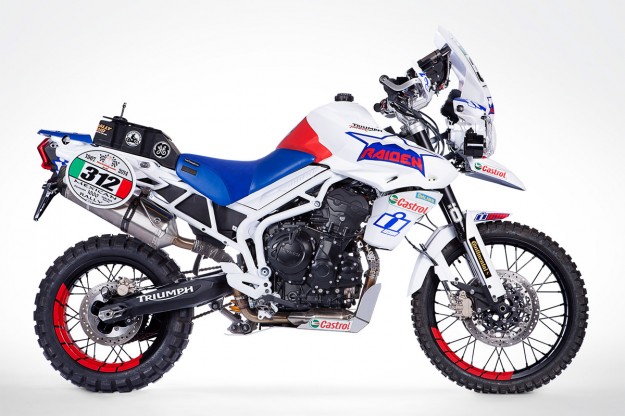
Icon Raiden Tiger 800 XCs

Triumph Tiger 800 XC Mexican 1000 bike
A sense of humor is not something you normally associate with hardcore desert racing. But this Triumph Tiger 800 XC is sporting Icon colors, so we’re guaranteed a twist on the usual.

The bike is nicknamed ‘Mantecore.’ If you’re a fan of popular culture you’ll spot the discreet reference to another white tiger—the recently-deceased big cat that featured in the routine of Vegas illusionists Siegfried and Roy.

Triumph Tiger 800 XC Mexican 1000 bike
There’s a yellow-and-blue bike too, known as ‘Turkish,’ which harks back to old-school cigarette brand colors. As Icon’s Joe Gustafson ironically notes, “Energy drink liveries lack a certain dose of refinement that the older vice brands had in spades.”

Triumph Tiger 800 XC Mexican 1000 bike
The bikes are far from being trailer queens. They’ve been built with the help of Triumph USA and its dealership Motoworks Chicago and this weekend, they’ll be lining up at the start of the NORRA Mexican 1000 rally. It takes place in the Baja desert, 30,000 square miles of scorched earth and an unforgiving environment for both man and machine.

Triumph Tiger 800 XC Mexican 1000 bike
Icon is taking this extremely seriously, and the Tigers have been prepped to within an inch of their lives. It’s going to be an extreme (and rare) endurance test for what are essentially ADV bikes.

Each bike has been modified with Öhlins suspension, an enduro-capacity tank from Safari Tank Australia, extra armor and rear fuel tanks from Rally Raid, a rally navigation panel, PIAA lighting, and Woody’s superlaced tubeless wheels.

Triumph Tiger 800 XC Mexican 1000 bike
Why the venture into rallying? After all, Icon is known for its sportbike gear and, via the Icon 1000 brand, its retro/custom-tinged apparel. But next year, the Portland-based company will launch a range of heavy-duty ADV gear called Raiden. We’re told it’ll combine rugged, expedition-level design with that signature Icon edginess—and the Mexican 1000 race is part of the testing program.

Triumph Tiger 800 XC Mexican 1000 bike
The four riders of these two bikes will be testing the new gear, with Icon’s own Joe Bolton and Ernie Vigil piloting the yellow Tiger. Keep an eye on their progress via the #Mexican1000 hashtag on Instagram, Facebook, and Twitter.

Triumph Tiger 800 XC Mexican 1000 bike

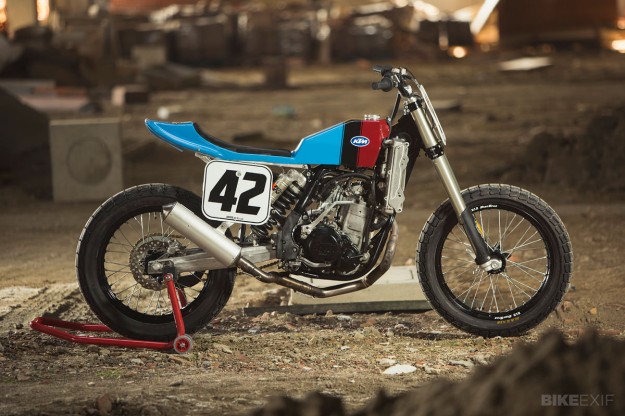
Flat tracker by Lorenzo Buratti

Tracker by Lorenzo Buratti
There’s something strangely appealing about flat tracker bikes. Maybe it’s the stripped-back look. Or the stubby proportions. Or the way the front ends always look so clean without a brake.

There are a lot of good looking trackers out there, but this is the best we’ve seen for a long while. It’s the work of Lorenzo Buratti, a man who has lived his life on two wheels. He started out as a BMX freestyler in his teens, then raced in African rally-raids before switching to enduro and motocross.

Tracker by Lorenzo Buratti
These days, at the age of 44, Buratti designs beautiful furniture and builds the occasional custom bike. But the racing itch has never really gone away. “I realized that I needed a break to recharge my batteries,” Lorenzo says. “And to me, this only means one thing—weekends spent battling with my friends on a track!”

The base bike for this project is a 2005 KTM 450 EXC. “In my enduro racing years, I competed a lot on this kind of KTM and I know it very well,” says Lorenzo. “I also wanted something very quick to work on during intervals between races. Hence the monocoque-style bodywork, which lifts up easily to reveal the top of the frame.

Tracker by Lorenzo Buratti
It was built to Lorenzo’s design by the Italian factory Europlast Succi, a world leader in vintage fiberglass. With a quick release fuel hose, it takes about ten seconds to open.

Given his racing experience, setting up a bike for racing is second nature for Lorenzo. He’s used 19” wheels shod with Maxxis DTR tires, and tuned the suspension with Andreani components. The exhaust system is hand-made, and the engine cases hide a balanced crankshaft and high compression piston.

Tracker by Lorenzo Buratti
Lorenzo cut the rear subframe and modified it to lower the seat and center of gravity. And because there is no battery on board, the electric start is gone.

Lorenzo has just given the bike its first shakedown race, in the Italian Flat Track Championship. He made it into the final of his first event, which is pretty good for a chap of his age on an untested bike.

Tracker by Lorenzo Buratti
If you have an enduro or motocross bike and want to convert it into a ready-to-race tracker, then Lorenzo is your man. Drop him a line via the lorenzoburatti.com website or Facebook page.

Images by JB Fotoblog.

Tracker by Lorenzo Buratti

Sprintbeemer by Lucky Cat Garage

BMW racing motorcycle
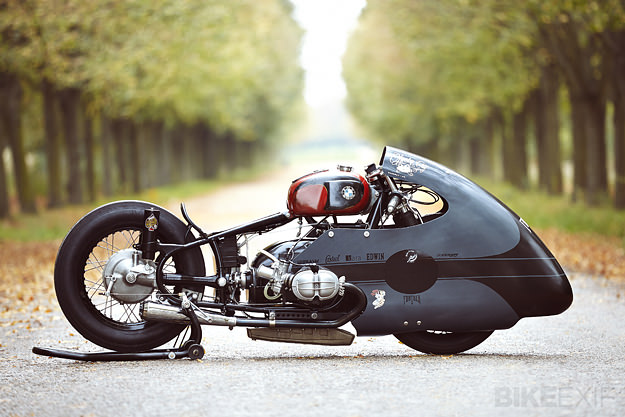
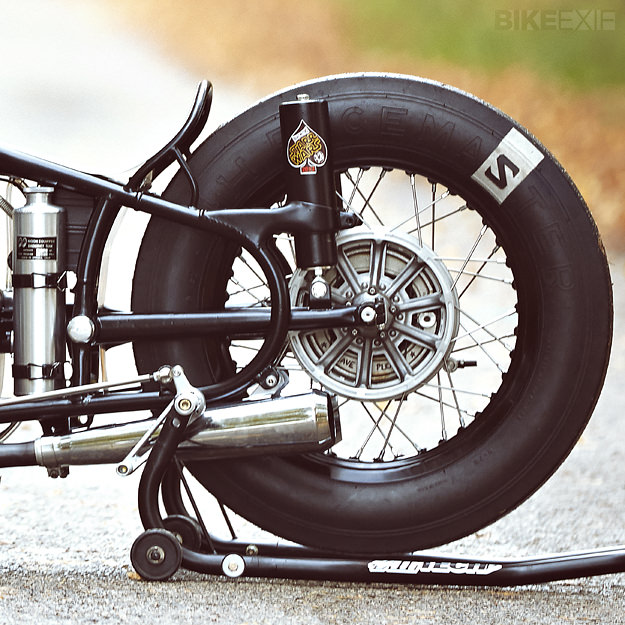
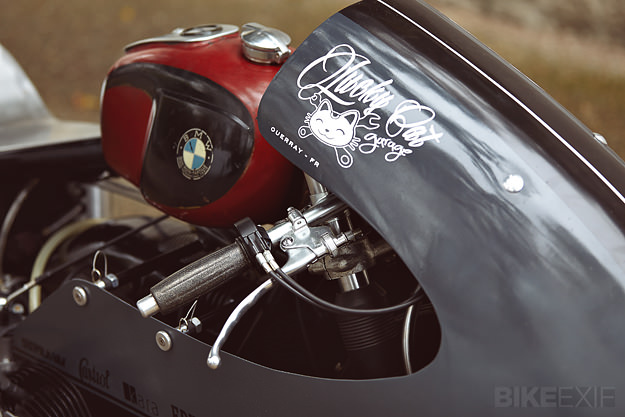
The inspiration for a bike build can come from the most unlikely of sources. In the case of this most unusual BMW sprint bike, it was a vintage M&H Racemaster drag tire.

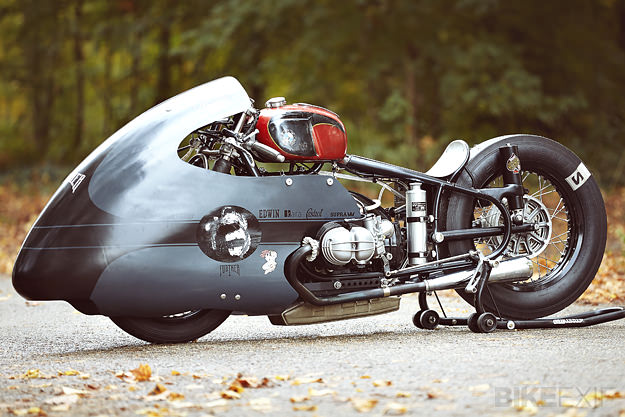
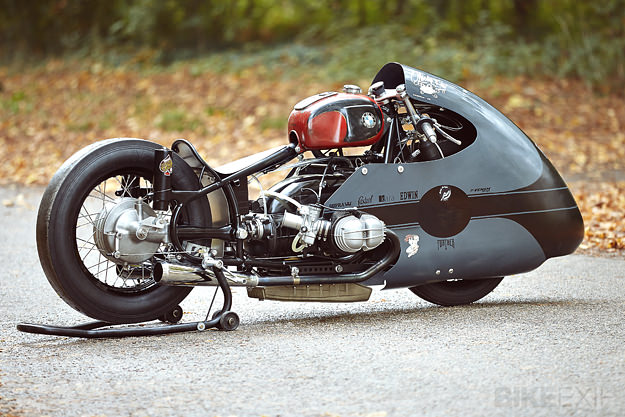
The tire belonged to the amiable Séb Lorentz of the Lucky Cat Garage, a familiar face on the European custom show circuit. While Séb was figuring out what to do with the slick, his family provided the answer: they bought him an Airtech dustbin fairing as a present. All Séb needed now was a frame, two wheels and an engine.

BMW racing motorcycle
Séb is not only an accomplished builder, but also works for BMW Motorrad France. And so the Sprintbeemer was born—a bike focused on speed and acceleration, with a hefty dash of style. “It has to look fast to frighten competitors,” he laughs. The goal was audacious: to win the Starr Wars sprint race at the huge Glemseck 101 festival in Germany.

BMW racing motorcycle
Sprintbeemer is a cocktail of parts from the 50s to the 90s, with an S 1000 RR superbike battery hiding in there somewhere. The modified chassis was an R50/2 in a previous life, and the shortened fork and front stoppers have been swiped from a R75/5. Séb added an air scoop and vent holes to the drum brake, and machined the wheel hub to save weight.

The swingarm is from a BMW R100/7 and the rear end is suspended by adjustable billet aluminum struts, hidden inside vintage shock covers. Power goes through a short-ratio R60/6 transmission. The drag slick that started it all has been mounted onto an 18” Morad wheel, with an Avon Speedmaster wrapped round the 19” Excel front rim.

BMW racing motorcycle
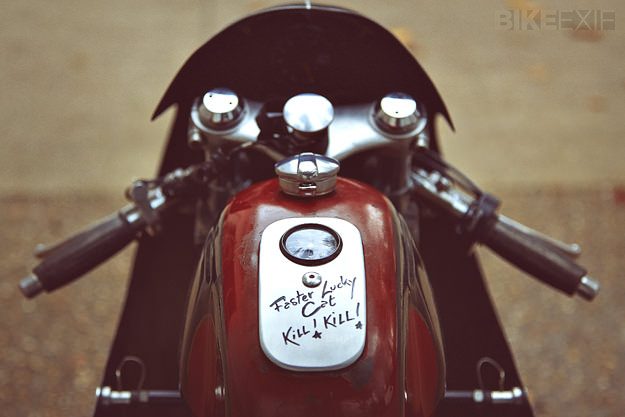
Séb is not sure what the tank is, though. It’s an unbranded barn find, maybe from a 1950s French or Italian sport moped. It’s been treated to a high-flow petcock, an aluminum cap and an engine temperature meter.

Just ahead are a Scitsu tachometer and Menani clip-ons—wearing black glitter Amal-style grips—and a Domino GP throttle. The aluminum seat pan is handmade, and the silver bottle just head of the rear wheel is an oil catch can—a modified emergency tank from Mooneyes in Japan.

BMW racing motorcycle
The star of the show is the engine, though. It’s an R 100 RS motor treated to big valves, breathing through Dell’Orto PHM 40 carbs. A 336-spec cam and lightened flywheel help the motor spin up fast, and Vattier race headers hooked up to race megaphones complete the package. The clutch is essentially stock, but beefed up with an HPN ceramic plate, and the R 100 R gearbox has inverted gears for faster and easier shifting.

But just as the bike was coming together, luck ran out: Séb broke his leg badly in a BMX crash and ended up in a wheelchair. Friends rallied round to help, and Sprintbeemer was finished—the night before the journey over the border to Glemseck.

BMW racing motorcycle
Sylvain Berneron—aka Holographic Hammer—drove Séb and his bike to Glemseck in a truck. Sylvain then donned leathers and a helmet and sent Sprintbeemer screaming down the track to victory, adding to the trophy he won on his own Suzuki at Wheels & Waves.

As winter approaches in France, Séb is rolling the BMW back into his workshop. But keep an eye out for it in the spring. With a new, shorter-ratio transmission due to be installed, Sprintbeemer promises to be even faster next year.

Images by Daniel Beres. Follow the adventures of Séb via the Lucky Cat Garage website and Facebook.

Triumph 6T Thunderbird salt racer

Triumph 6T Thunderbird
There’s something strangely compelling about motorcycles built solely to race down the Bonneville salt flats. Stripped of all fripperies, they’re designed to operate in a hostile environment that tests both man and machine.

This Triumph 6T was built by Dick Smith of The Baron’s Speed Shop in the UK, and it has that odd beauty in spades. Photographer Gary Magerum captured it at rest after it grabbed the record in the Pushrod/Fuel/Special construction class.

Triumph 6T Thunderbird
The bike is based around a duplex pre-unit frame from The Factory Metal Works in the States. Baron’s then slotted in a 1960 6T (Thunderbird) motor, heavily modified with a three-piece crank, a flywheel made from EN40B steel, and vintage Harman & Collins drag cams. Most moving components have been lightened, from the timing gears to the pushrods and rocker arms.

Triumph 6T Thunderbird
The pistons are 10:1 high compression items from MC Cycle, sucking gas from a pair of 1.5-inch Amal 3 GP carbs supplied by Burlen Fuel Systems. The gearbox is a 1957 pre-unit fitted with five-speed internals. As if that’s not enough, the bike is tuned to run on straight methanol, and lubed by Morris’ legendary R 30 castor oil.

Triumph 6T Thunderbird
The rims are 19” Akronts front and back, shod with Avon tyres, and the unashamedly prominent nose cone is a modified Hagon item.

The sound (and smell) of this Thunderbird must be amazing. Another good reason to add the BUB Speed Trials to the bucket list.

With thanks to photographer Gary Margerum. Head over to the Baron’s Speed Shop website for more classic British iron.

Triumph 6T Thunderbird

BSA Trackmaster

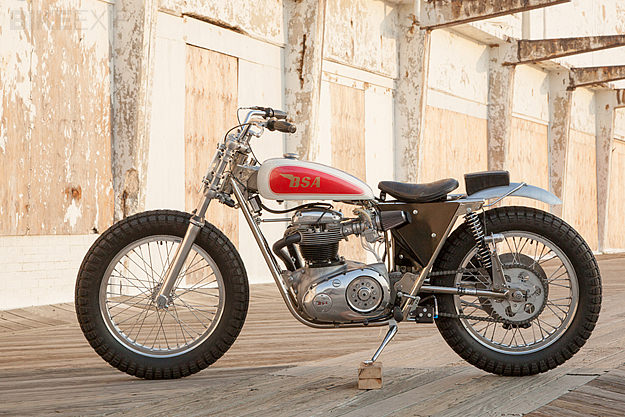
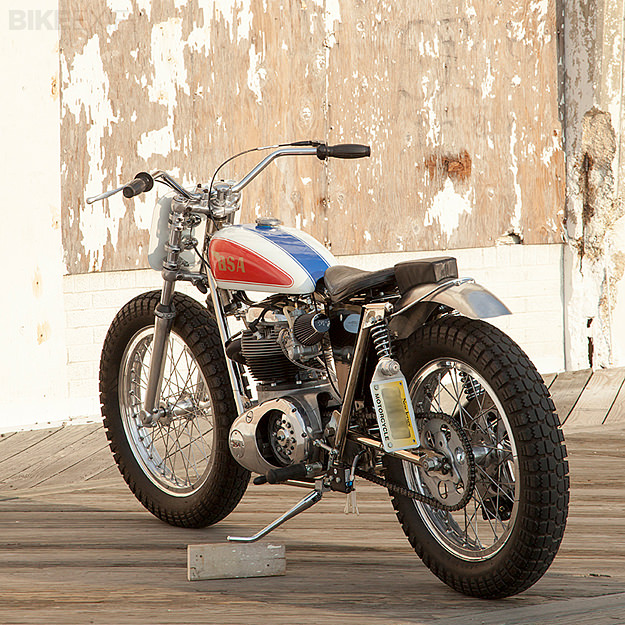
BSA A65 Trackmaster by Bill Bradshaw, resurrected by Dave Schostkewitz of Classic Cycles, New Jersey.
If there’s a growing trend in custom motorcycles today, it’s towards street trackers: road-legal versions of the flat track bikes that raced in the 1960s and 1970s. With small tanks, wide bars and fat tires, they’re good-looking bikes stripped down to the essentials.

Machines like this lovely BSA Trackmaster, resurrected by New Jersey’s Phil Capozzi, are the archetype. And this BSA has the history to match its purposeful looks. “About 35 years ago, back in my college days, I was introduced to a guy named Bill Bradshaw,” Phil recalls. “At the time, Bill owned and wrenched on BSA flat track bikes at racetracks up and down the east coast.” It was the time of riders such as George Richtmeyer, Dave Singleton and “Rowdy” Rick Stone. Phil hitched a lift with Bradshaw’s crew, helping out with the bikes. “To this day I’ve never forgotten the sights, sounds or smells from that great adventure.”

BSA A65 Trackmaster
Fast forward to 2009. Phil paid a visit to Bradshaw at his Connecticut home, and talking about the old days rekindled the flat track fire. “I decided then and there I had to have one of my own. But it’d been years since Bill worked on those BSAs: The parts were scattered all around, with many lost to time and fading remembrances.”

Phil returned home with boxes of parts, determined to collect as many of the original fragments as he could find. “I wanted to turn a great memory into a three-dimensional reality. The idea: build a BSA from as many original pieces as possible.”

With help from Bradshaw and Rick Stone over the next couple of years, Phil managed to source a Trackmaster racing frame, a Bates seat, and Ceriani forks (including triple trees). He also located authentic tires, Borrani rims, Kennedy quick-change hubs with knockoffs and, best of all, an original fiberglass gas tank with intact paint.

BSA A65 Trackmaster
To help build the BSA, Phil roped in Dave Schostkewitz of Classic Cycles, the go-to guy for vintage British bikes in New Jersey. “Dave built a strong motor. Since this was going to be a street tracker we settled on a reliable A65 650cc setup with some neat upgrades, both old and new.”

For extra power, Dave installed an original Spitfire cam and new Mikuni VM roundslide carbs, duplicating those used on the original BSA race motors. For dependability he used a Bob Newby Racing billet clutch assembly/belt drive, a Boyer electrical system with a high output alternator, and a li-ion battery.

“The two sets of original pipes I had were beyond repair,” Phil reports, “so Dave handcrafted new megaphone pipes that mimick the originals.” To keep it in the family, Dave’s son fabricated the new rear fender.

BSA A65 Trackmaster
The frame needed considerable work. The original swing arm was lost and the Trackmaster replacement needed extensive remedial work. Fatigue cracks and ugly welds from back in the day were cleaned up, new tabs were added, and the complete frame was nickel-plated once again. For stopping control, a new Wilwood brake caliper and master cylinder were used—at the rear wheel only, in true flat track fashion. “Dave also used his last ‘new’ original Amal throttle to make this bike do what it’s made to do—Go!” says Phil.

For Phil, the finished product is a step back in time. “It’s even better than I could have ever imagined,” he says. “I can’t express my excitement to have come full circle on my decades-old dream of having an original Bill Bradshaw BSA to call my own.”

Photography (c) 2013 Erik Landsberg.

BSA A65 Trackmaster

Moto Guzzi “Suzuka 8 Hours” racer

Moto Guzzi endurance racer
The custom scene is awash with concepts and Photoshop renders and imagined bikes. But designer Davide Caforio, who flits between Milan and Rome, has turned an inspired idea into reality.

Caforio is an accomplished Moto Guzzi builder, and well known within his native Italy. He’s now created a tribute to the endurance machines that fought at the Suzuka 8 Hours in the 80s, racing through the night with headlights blazing.

Moto Guzzi endurance racer
Caforio describes his Le Mans Mk IV as having a “false history.” It’s a motorcycle from a parallel universe, one that pitched the Mandello Del Lario factory against the Suzukis of Wes Cooley and Graeme Crosby, or Wayne Gardner’s Honda.

Moto Guzzi endurance racer
It’s not a cosmetic job. The engine is heavily modified, bored out to 1150 cc with twin spark heads, big valves and uprated cams. Everything is balanced and the flywheel has been lightened to sharpen response. Fuelling comes from Dell’Orto-PHM carburetors.

Moto Guzzi endurance racer
The frame has been modified and lightened, and the aluminum swingarm is hooked up to a race-spec WP monoshock. Up front are a set of new Marzocchi 41.7mm forks, with steering aided by a Bitubo damper. The wheels are race-spec too, 18” at the back and 16” at the front, shod with Avon tires. The brakes are Brembo Serie Oro.

Moto Guzzi endurance racer
Caforio has nailed the look of the typical 1980s endurance racer with his custom fiberglass bodywork, which is loosely modeled on the Yamaha TZ750 two-stroke. The aluminum tank houses a vintage Bimota filler cap and the rearsets are replicas of classic Bimota items. The paint is unapologetically patriotic, using the colors of the Italian flag, with a sprinkling of decals for authenticity.

It’s not elegant, and there’s little delicacy to be found in the lines. But there’s an appealing brutality about this machine that gets me thinking, “What if?”

Head over to Davide Caforio’s website Ruote Fiere for more Moto Guzzi goodness.

Moto Guzzi endurance racer